No link between DGEME Lt Gen Sahni and Thailand assault video, says Army
The clarification came after several posts circulated online, falsely linking a viral video from Thailand to the senior Indian Army officer.
After weeks of artillery fire, air strikes and mass displacement, the ceasefire along the Thailand-Cambodia border has brought a moment of stillness to a conflict that was spiralling dangerously out of control.




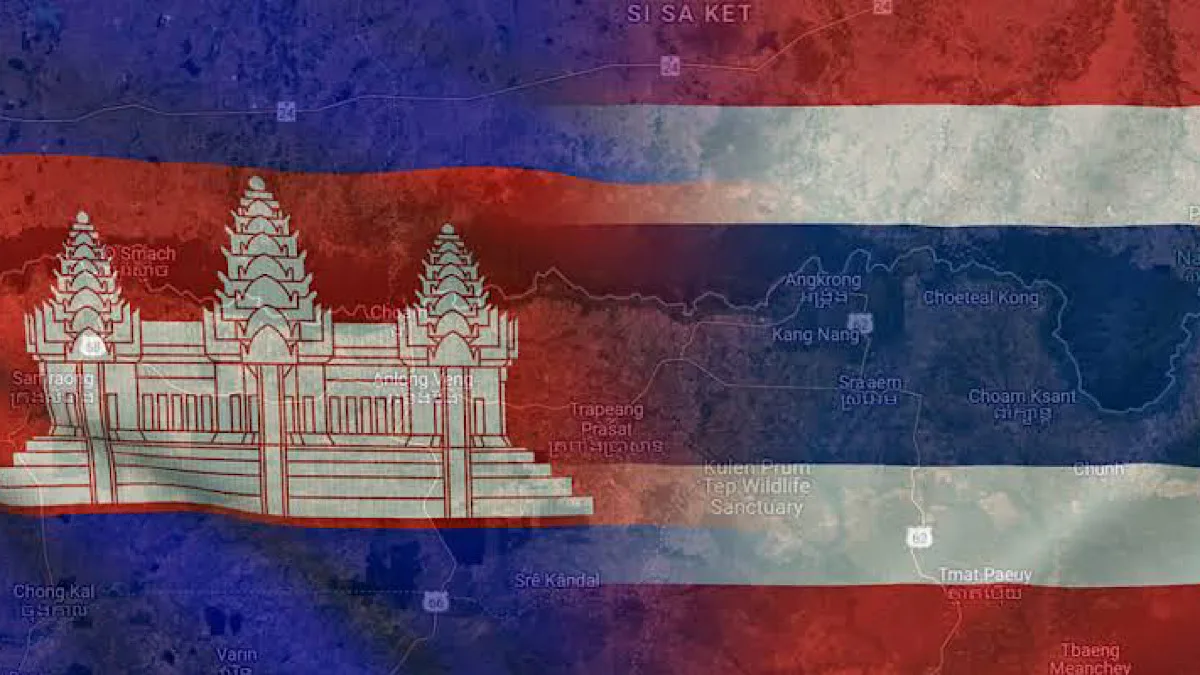
Thailand and Cambodia flags (Photo:X)
After weeks of artillery fire, air strikes and mass displacement, the ceasefire along the Thailand-Cambodia border has brought a moment of stillness to a conflict that was spiralling dangerously out of control. For nearly three weeks, civilians on both sides lived with uncertainty, uprooted from homes and livelihoods by fighting rooted in a dispute far older than any of them. The pause in hostilities is therefore welcome, but it is also precarious ~ more an intermission than a resolution.
At its core, the agreement reflects exhaustion rather than reconciliation. Both militaries have paid a price: casualties among soldiers, damage to equipment, and reputational costs at home and abroad. Cambodia’s setbacks on the battlefield and Thailand’s concerns about repeated ceasefire violations have hardened attitudes rather than softened them. This explains the unusually guarded language surrounding the truce, with explicit warnings that any breach will invite retaliation. Peace, in this context, is conditional and transactional. The humanitarian dimension has been decisive. Nearly a million displaced people cannot remain pawns in a nationalist standoff indefinitely.
Advertisement
Allowing civilians to return and committing to landmine removal are not just confidence-building measures; they are admissions that the conflict had begun to exact unacceptable civilian costs. In Southeast Asia, where memories of protracted border wars and insurgencies remain vivid, displacement on this scale raises alarms well beyond the immediate theatre of conflict. External actors have played a quiet but consequential role. Diplomatic nudging from major powers and regional intermediaries helped push both sides toward the table, even if none claimed ownership of the outcome. That restraint is telling. Previous efforts to brand ceasefires as signature diplomatic achievements created political stakes that outlived the agreements themselves.
Advertisement
This time, the emphasis is on de-escalation rather than spectacle ~ a pragmatic shift that may improve the ceasefire’s chances, however marginally. Still, the deeper problem remains unresolved. The border dispute is entangled with history, identity, and domestic politics. Incidents that might otherwise be dismissed as symbolic ~ patriotic songs, flag-waving visits, localised skirmishes ~ carry outsized emotional weight. Once nationalist sentiment is inflamed, political leaders find it difficult to step back without appearing weak. This is the real threat to the ceasefire: not deliberate escalation, but the accumulation of small provocations that push commanders and politicians past the point of restraint.
What happens next will depend on whether both sides treat the ceasefire as a bridge or a shield. Used as a bridge, it could open space for verification mechanisms, sustained dialogue, and gradual demilitarisation of contested areas. Used as a shield, it merely freezes positions until the next trigger is pulled. History suggests the latter outcome is more common, but not inevitable. For now, the guns are quiet. That alone is significant. But silence along a disputed border is not peace; it is an opportunity. Whether Thailand and Cambodia seize it will determine if this ceasefire is remembered as a turning point or just another pause before the next round of fighting.
Advertisement